Santa Clarita Valley, California
Hard groundwater (spots, not a health call from the utility), chloramine since 2005, and LACSD says automatic salt softeners that dump brine to the sewer are out.
California · Salt-softener legality
- Chloraminesince 2005
What to do in Santa Clarita Valley
Portable-exchange softening — not a brine tank
A self-regenerating salt softener that drains to the sewer is prohibited here.
Portable-exchange tanks, if that exception applies at your address. The resin still removes hardness. The salt work happens off site. Do not install a self-regenerating unit to the sewer here.
Hard water, and a self-regenerating brine tank is not the cited legal path here.
Amazon lists shipping and returns on that product page. We do not warehouse the equipment.
Also for the kitchen
Under-sink reverse osmosis
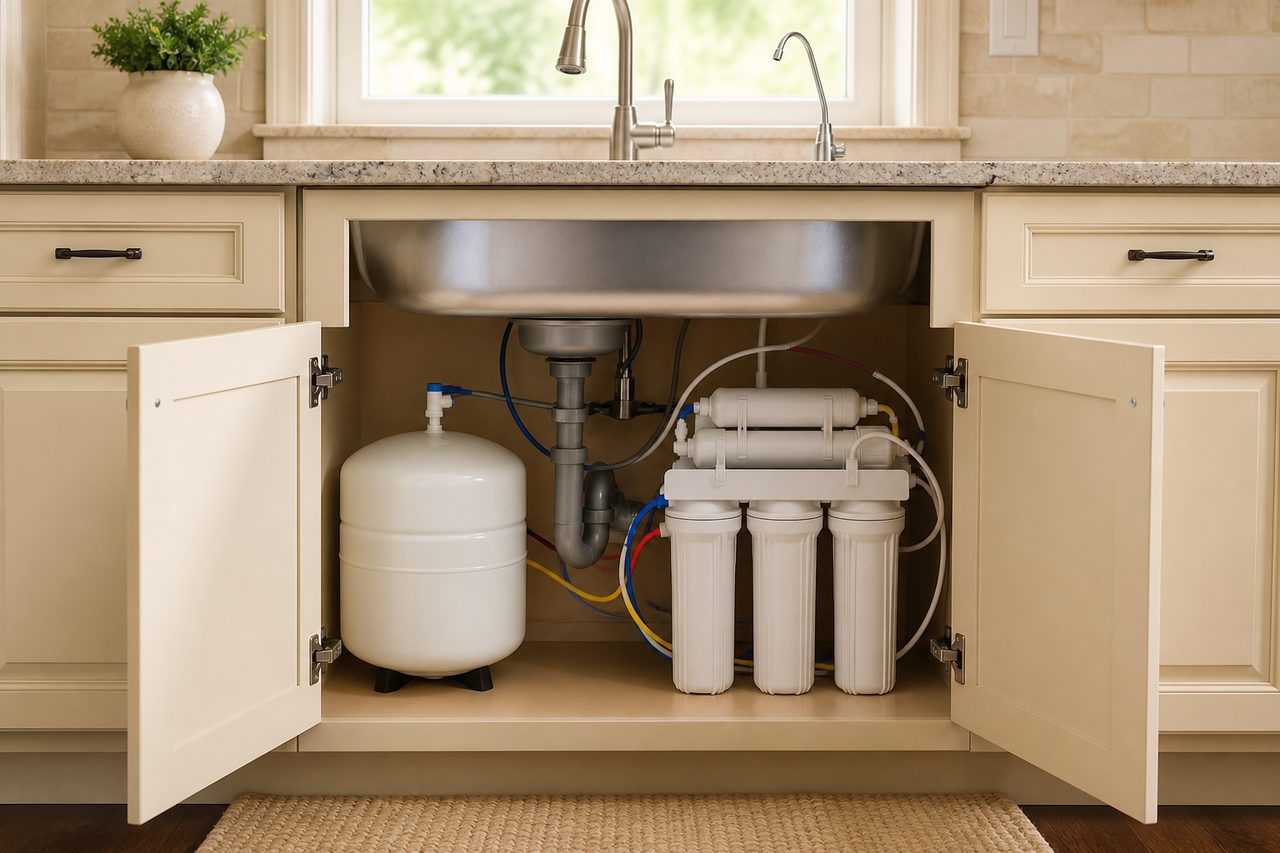
Cloud RO is an under-sink reverse osmosis system — NSF/ANSI 58, kitchen tap, not a whole-house tank. The primary button is a tagged Amazon under-sink RO listing. Cloud buy-direct and Waterdrop sit under that. Check the exact listing if PFAS is why you are shopping. A certifier-listed pitcher is the cheap first step.
Buy Cloud RO directShop Waterdrop reverse osmosisShop PFAS-listed pitchers
Some links are affiliate links. If you buy through one, we may earn a commission. That does not change the match, and it is not a medical claim.
As an Amazon Associate we earn from qualifying purchases.
Other options that still fit
Salt-free conditioner
A salt-free conditioner changes how scale sticks. It does not soften. Soap and spots stay closer to untreated. No brine line.
Whole-house catalytic carbon for chloramine
Catalytic carbon with a chloramine claim (NSF/ANSI 42 for chloramine). Regular chlorine carbon is the wrong box.
Test the tap first
A homeowner kit is a start. It is not a state-certified lab. Use a certified lab when the decision is expensive.
Softener vs carbon vs under-sink RO
A sketch for Santa Clarita Valley, tied to the best match above. Not a quote.
| Box | What it does | Ballpark (estimate) |
|---|---|---|
| Salt-based softener | Removes hardness. Needs a drain. Illegal in some sewer districts. A district rule against a self-regenerating brine tank is cited. Do not price one for the sewer here. | About $800–$2,500 for a common residential unit (equipment). Installed jobs run higher. |
| Whole-house carbon | Chlorine or chloramine taste — match the listing. Does not soften. | About $400–$1,800 for a typical tank-and-head kit (equipment). |
| Under-sink reverse osmosisBest match | Kitchen tap. Check NSF/ANSI 58 if PFAS or nitrate is why you are shopping. | About $200–$600 on Amazon search; named under-sink units vary. |
These are ballpark equipment ranges, not installed quotes and not what a dealer will write on a kitchen-table sheet. Prices move. Confirm the sewer rule before you price a brine tank.
On the report
- Water utility
- Santa Clarita Valley Water Agency (SCV Water)
- Hardness
- SCV Water confirms hardness from calcium and magnesium in groundwater and describes spotting as an aesthetic issue. We do not invent a grains-per-gallon figure; read the current CCR for your division and test the tap. — SCV Water, Understanding Water Quality
- Disinfectant
- Chloramine (changed from chlorine in 2005) — SCV Water, Understanding Water Quality
- Sanitation district
- Los Angeles County Sanitation Districts — Santa Clarita Valley
- Brine / salt to the sewer
- Self-regenerating salt softeners prohibited (district rule). LACSD prohibits automatic salt-based softeners that discharge chloride to the sewer. Measure S (2008) required removal of those units. Santa Clarita’s plumbing code excepts portable-exchange tanks that discharge no brine on site.
How to get your water tested
The report on this page is for the public water system. It is not a test of the faucet in one house. Pipes inside a house can change the water.
For a test of your own tap, use a laboratory on the California State Water Resources Control Board list of certified drinking-water labs.
If your water comes from a private well, test it once a year. A city water report does not cover a private well.
Also around here
Extra context besides the utility report and the chart above — geology, an unregulated table, or a published study. Not a second set of printed tap numbers.
- MicroplasticsWHO’s 2019 review examined studies that found microplastic particles in treated tap and bottled water in many places. That is a published-occurrence finding, not a number from this city’s water-quality report, and we do not invent a particles-per-liter count for the tap.Microplastics in drinking-water — World Health Organization
- PerchlorateSCV Water says perchlorate has been detected in some drinking-water wells from the former Whittaker-Bermite site above the Saugus Formation, and that they run wellhead treatment. Not a distribution average we invented.Perchlorate and VOCs — Santa Clarita Valley Water Agency
- TCE and PCEThe same SCV Water page says TCE and PCE have been detected in some wells tied to that site. They describe wellhead treatment and distribution monitoring. Not a tap average we invented.Perchlorate and VOCs — Santa Clarita Valley Water Agency
- PFASEPA’s Fifth Unregulated Contaminant Monitoring Rule required community systems this size to test 29 PFAS and lithium in 2023–2025. Open the UCMR 5 Data Finder for this PWS. We do not invent a detection.Fifth Unregulated Contaminant Monitoring Rule — U.S. Environmental Protection Agency
Questions we can answer from the report
How hard is Santa Clarita Valley tap water?
SCV Water confirms hardness from calcium and magnesium in groundwater and describes spotting as an aesthetic issue. We do not invent a grains-per-gallon figure; read the current CCR for your division and test the tap. Source: SCV Water, Understanding Water Quality.
Does Santa Clarita Valley use chlorine or chloramine?
Chloramine (changed from chlorine in 2005) Source: SCV Water, Understanding Water Quality.
Is a salt-based water softener legal in Santa Clarita Valley?
Self-regenerating salt softeners prohibited (cited district rule). LACSD prohibits automatic salt-based softeners that discharge chloride to the sewer. Measure S (2008) required removal of those units. Santa Clarita’s plumbing code excepts portable-exchange tanks that discharge no brine on site. A self-regenerating salt softener that drains to the sewer is prohibited here. This is not a legal opinion.
What should I do about Santa Clarita Valley tap water?
Portable-exchange softening — not a brine tank. Portable-exchange tanks, if that exception applies at your address. The resin still removes hardness. The salt work happens off site. Do not install a self-regenerating unit to the sewer here. If the job is drinking water at the kitchen, under-sink reverse osmosis is the usual path. Cloud RO is the preferred Amazon listing on this site (tag tapmatch-20). We do not claim we use it.
Sources
- Understanding Water Quality — SCV Water. Accessed 2026-08-31.
- Automatic water softeners in the SCV — LACSD. Accessed 2026-08-31.
Updated August 31, 2026. Numbers here are what the utility's report or the state record printed, plus the sewer rule. No invented detections.